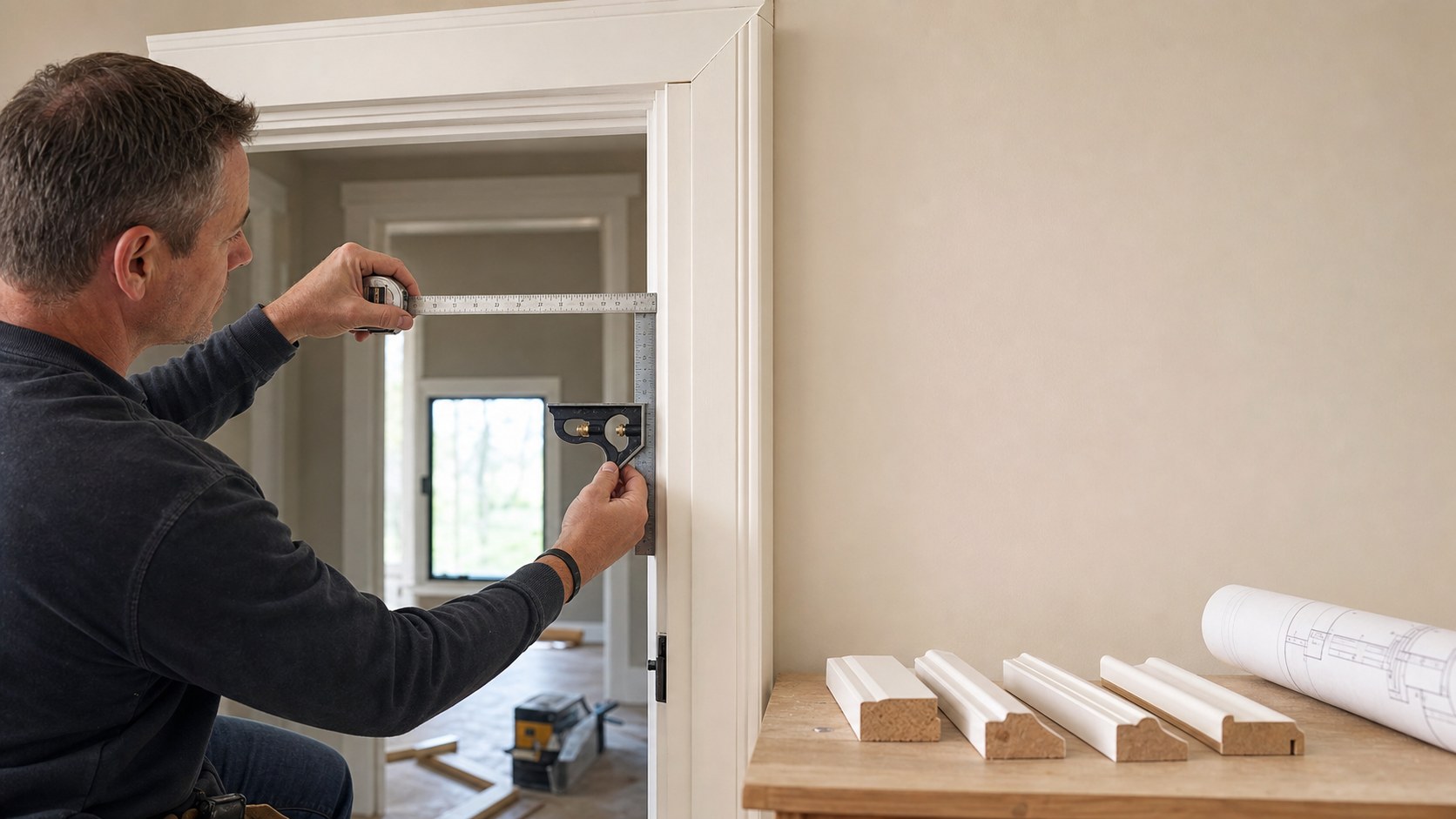
Door Casing vs. Decorative Moulding: What's the Difference, and Why Mixing Them Up Costs You
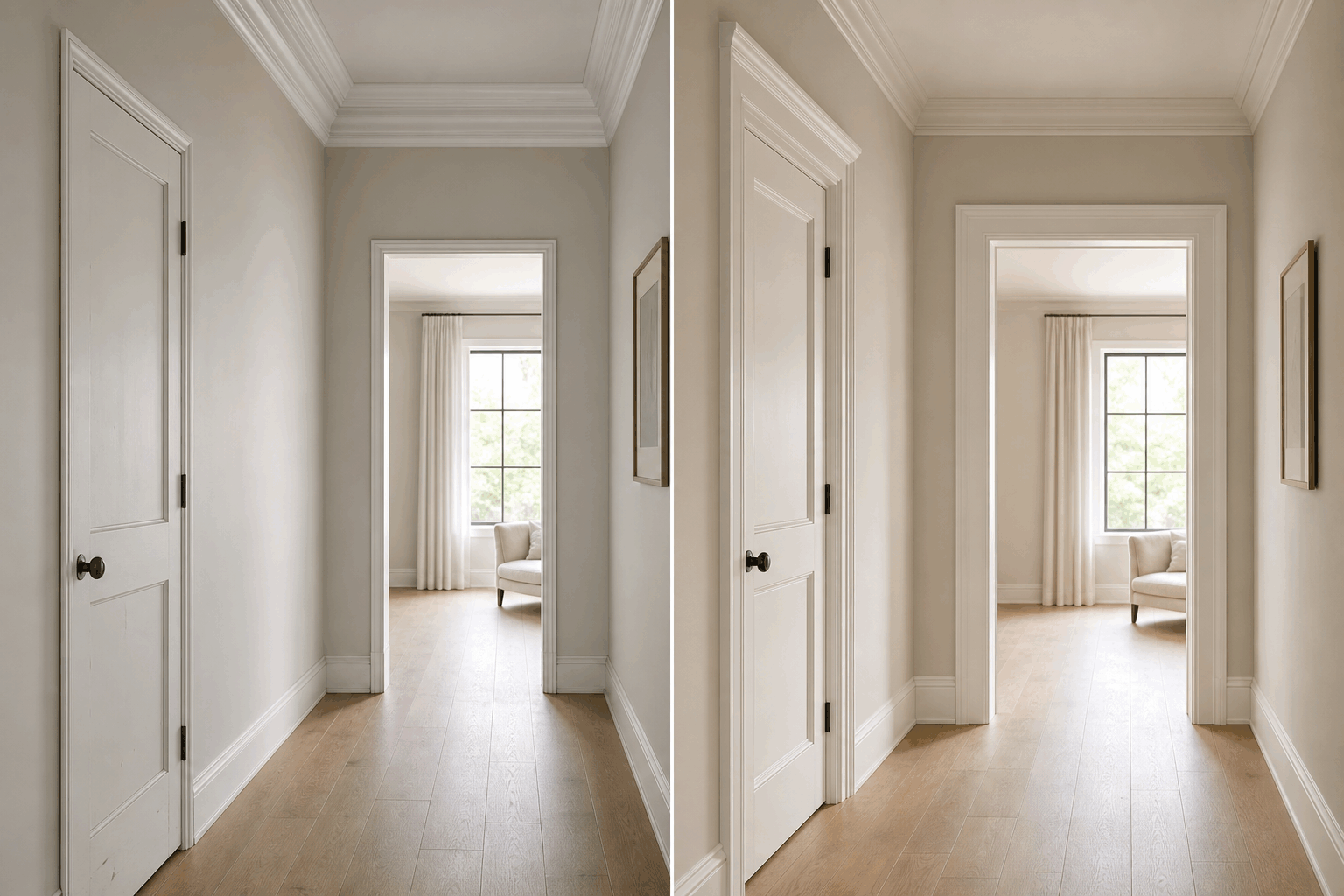
Here's a mistake I see on purchase orders more often than you'd think. A buyer finds one profile in one material and writes on the PO: "Use this for all trim." Everything is made from one product: the door surround, the wall lines and the ceiling cornice. It feels efficient. Then the container lands, the installers start, and the problems begin: the wall lines look too heavy, the door trim doesn't sit right against the frame, and the finish doesn't quite match from one run to the next.
The reason for this is usually the same. Door casing and moulding are two different systems that do two different jobs, but someone treated them as if they were the same. This guide explains the difference between a door casing line and a decorative moulding, why mixing them up can cause problems, and how to buy interior mouldings without ending up with a mess on site.
Why is "moulding" treated as one big group?
It's easy to see why there's confusion. On a spec sheet, it all says "linear trim, sold by the metre, in wood or MDF or PVC." From far away, a door frame and a wall decoration can even look the same.
But they don't behave the same way once they're on a building. The door casing is the part that goes around the door frame and the wall. It has to be the right size so that it fits properly, and it needs to be strong enough to take the daily wear and tear of being touched by hands, trolleys and cleaning materials. Decorative moulding, on the other hand, is usually found on flat wall and ceiling surfaces that aren't often touched. Its main purpose is to give a room a certain look.
When you flatten both into "trim," three things tend to go wrong: the wrong material ends up in the wrong place, the profiles don't match each other visually, and the finish batches don't match. These things aren't included in the quote. All of them show up when they're supposed to.
The most important thing every project buyer should know
If you ignore the marketing talk, it's really about this.
What Is Door Casing?
The door casing (also known as door trim moulding) is there to be used, not just to look at. Its job is to finish and protect the area where a door meets the wall. It has to fit the door frame, hide the gap, and survive being touched. When you search for interior door trim moulding, you're looking for a product that goes at the door and is judged on how well it fits and how strong it is, as well as how it looks.
What Is Decorative Moulding?
Decorative moulding (decorative door trim moulding, crown, chair rail, wainscot, cornice, panel lines) is decorative first. Its job is to define proportions, add shadow and rhythm to walls and ceilings, and carry the design language of a space. It doesn't have a counterpart to align with, and it usually isn't damaged by physical pressure. It's judged on how well the miters fit together, how consistent they are, and how cleanly they close.


Material and structure: an engineering look
This is where the two differ in ways that matter for your Bill of Materials (BOM).
The door casing must be stable in size and able to withstand impacts. It's often found near the floor, near traffic, and near moisture (like entryways or bathrooms). This means you should choose materials like moisture-resistant MDF, WPC/PVC, or properly dried solid wood. These materials won't swell where the door meets a damp wall, and won't dent the first time a cleaning cart hits them. The back profile is also important: the casing often needs a slight bend or flexibility to sit flat against a wall that is not straight next to the frame.
Decorative moulding can be made to be less strong, because it's not getting hit. Lightweight materials like PS (polystyrene) foam, light MDF, or PU are often used for crown and wall lines. They're easy to handle overhead, easy to miter, and cheap to run in long lengths. They can't take any kind of rough treatment, which is exactly why you don't want them near a doorway.
So if a supplier says they're using the same material for everything, ask questions. You can't use the same material for a ceiling cornice and a bathroom door surround. The way they are built is just different.
Door Casing vs. Decorative Moulding: Key Differences
Treat them as two coordinated systems, not one interchangeable product line.
- Application: Door casing frames openings and meets the floor; decorative moulding shapes walls and ceilings.
- System components: Door casing works with the door frame and skirting/baseboard; decorative moulding works with crown, chair rails, wall panel lines, and ceiling cornice.
- Profile attributes: Door casing typically needs a more substantial, impact-resistant profile and a back shape that can sit flat at the frame-to-wall junction; decorative moulding prioritizes consistent face geometry, clean shadow lines, and lower weight for long or overhead runs.
- Performance priority: Door casing is selected for dimensional stability, moisture resistance, and everyday durability; decorative moulding is selected for clean miters, repeatable profiles, and ease of handling.
- Installation and finish: Door casing must align closely with the frame and adjacent skirting; decorative moulding must join cleanly across long walls and corners. Both systems should share a coordinated colour and finish, but they do not need the same profile or material.
How to make a procurement decision
How to tell which is which on your BOM
When I'm helping a buyer clean up a trim BOM, we tag every line item by asking four quick questions:
- Where does it go? Doorway → casing system. You can put up decorations on the wall or ceiling.
- Is it touched? Yes, it needs a material that can withstand impact. No → face profile can lead.
- Does it meet moisture? Yes → moisture-resistant grade, no exceptions. This is the most common mistake.
- Does it fit into a frame? Yes → casing that matches the size of the door frame. No → decorative, judged on miters and profile.
If you run every trim line through those four and the two systems, they will sort themselves out quickly. It takes ten minutes and it stops you having to find out on site, which would be expensive.
Don't regret your purchase when you buy interior decorative moulding
When comparing quotes, there are a few things to consider when it comes to decorative items:
- The profile is the same every time. Decorative moulding is all about clean, repeatable shadow lines. If the profile moves between batches, your miters won't close properly and the issue will be visible at every corner. Ask how they handle profile tolerance when there are large orders.
- How long it is and how easy it is to hold. Longer lengths mean fewer joints and a cleaner wall. But longer, lighter mouldings can be shipped and stored more delicately, so the way they are packaged matters.
- Finish the match using your casing system. If the decorative lines and the door casing are meant to read as one scheme, they need to come from the same finish family — ideally the same supplier and batch.
- The weight is just right for the location. Overhead crowns should be light and easy to install. A chair rail that takes contact needs to be sturdier. Make sure the material is right for the place where it will be used.
- Miter behaviour. Some materials are easier to cut and glue than others. When you're making a lot of moulds, using a moulding that miters in a predictable way can save you real labour.
- Don't make it too complicated. The most expensive decorative profile isn't necessarily better if a simpler one can give the client the look they want with easier installation and fewer joints.
How Huayi Coordinates Both Systems
The best way to prevent material, profile, and finish mismatches is to source both systems from one manufacturer that understands the difference. At Huayi, the same application questions—doorway or wall, level of contact, and moisture exposure—are used to recommend the material and profile before quotation. What buyers should look for:
- They make casing and decorative lines, and can explain which material is best for each job.
- They match finishes across systems, so your casing, skirting and decorative mouldings share one colour and texture from the same production.
- They ask about the destination of each profile before quoting. A supplier who asks about doorways vs. walls, and moisture, understands the product.
- They hold profile tolerance at volume, so miters close in a consistent way across a large order.
- They pack for transit, because long, light decorative mouldings arrive damaged when packaging is not given much thought.
HUAYI APPLICATION EXAMPLE
Hotel Package: Two Systems, One Finish Standard
For a hotel package that includes bathroom door surrounds, corridor skirting, and lightweight wall mouldings, Huayi would split the BOM into two systems. The door casing and skirting would use moisture-resistant, impact-ready materials, while the wall mouldings would use lighter profiles designed for clean miters. All three product groups would be matched to one approved colour and texture, sampled together, and packed by application so installers can identify which pieces belong at openings and which belong on walls. This approach reduces the risk of swollen casing, weak doorway trim, and mismatched finishes.
Application spotlight: High-end residential mixed systems
The best example of this is upscale residential. A high-quality home often has a mixed material system. This means that some parts of the walls are made of one material, like wood, while other parts are made of a different material, like brick. This creates a clean look, where the material doesn't show. Sometimes, the door frames are hidden or have a very thin frame. This is called a frameless look. The walls and ceilings are decorated with mouldings, which can be anything from simple lines to elaborate designs.
That combination only works if the two systems are planned together. The casing has to be precise and durable at the doors; the decorative lines have to be consistent and neatly mitered across the walls; and the whole thing has to have the same finish so the room looks designed, not put together from parts. If you get the coordination right, it looks easy. If you skip this step, you'll end up with a house full of trim that doesn't quite match.
Frequently asked questions
Can door casing and decorative moulding be made from the same material?
This is sometimes the case, but it's not the norm. If you are in a dry, low-traffic area, you can use the same material for both. The outside of the door needs to be made of a stronger, moisture-resistant material, especially near moisture or where there is a lot of foot traffic. This is even more important than using a decorative trim. Choose the material based on where it will be used, not how easy it is to get to.
Which decorative moulding is best for projects that require a lot of material?
Lightweight and sturdy profiles (made from MDF, PS foam or PU) that are long and cut evenly. They are quick to install, don't need many joints, and are reliable. The most important thing for decorative work is that the profile is consistent and easy to handle, not that it is decorated as much as possible.
Can door casing be used for decoration?
To a certain extent. A casing profile with a decorative face can carry some of the design elements from the doorway. This is exactly what decorative door trim moulding is. But casing is built to work at openings, so using a heavy casing profile as general wall or ceiling decoration usually looks bulky and costs more than a purpose-made decorative line. Use each one in the right place, and let them work together.
Planning a Casing and Decorative Moulding Project?
Are you looking for casing and decorative mouldings for a project? Send us your layout, where you want each profile to be and how you want it to look when it's finished. We'll tell you which material goes where, make sure the whole system has the same finish, and send samples before you choose a container — so the two systems match when they're installed, not just on the spec sheet.
Request a Project RecommendationWhat Affects Bulk Entrance Door Trim Prices?
Interior Door Casing Styles: A Sourcing Guide for Getting It Right the First Time