
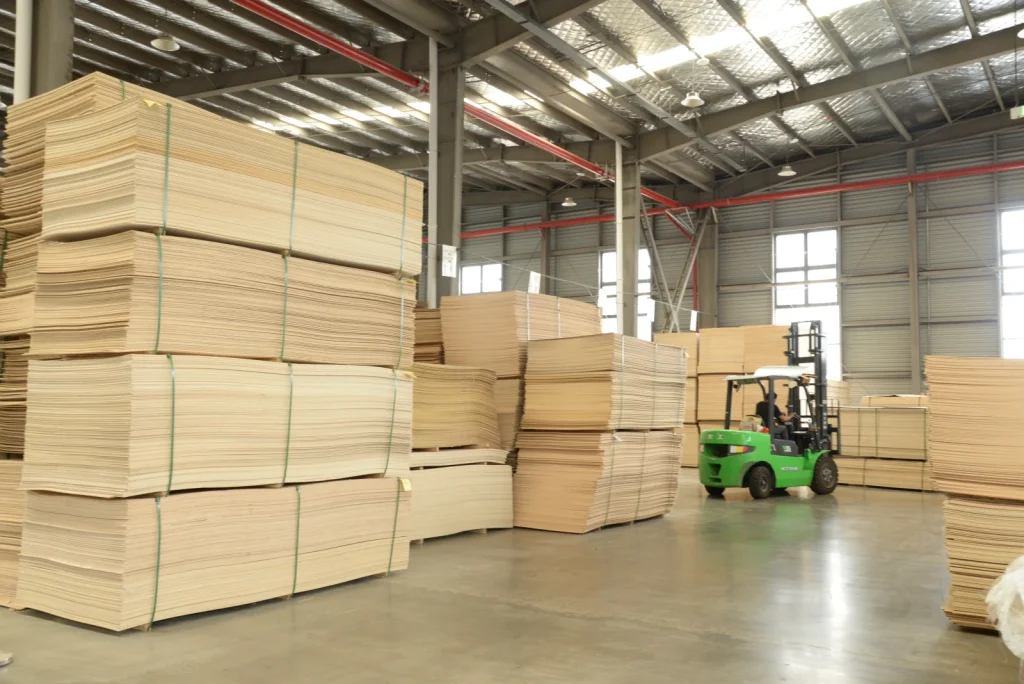
MDF, particle board and plywood can look alike in a stack of sheets, but they are built in different ways. That changes how they machine, hold screws, take paint or laminate and cope with moisture. Choosing the wrong one rarely shows on the day the furniture is delivered; it shows months later as sagging shelves, swollen edges or loose hinges.
This guide compares the three boards for buyers who make or source cabinets, furniture, doors and interior fit-out, and ends with the details to send when you order.
The short answer
- MDF for smooth painted or laminated faces and clean machined edges.
- Particle board for cost-sensitive flat panels such as cabinet sides and short shelves, usually with a melamine face.
- Plywood where strength, screw holding and tolerance to humidity matter most.
How Each Board Is Made
The differences start in the press. Look at the edge of each board and you can see how it was built.
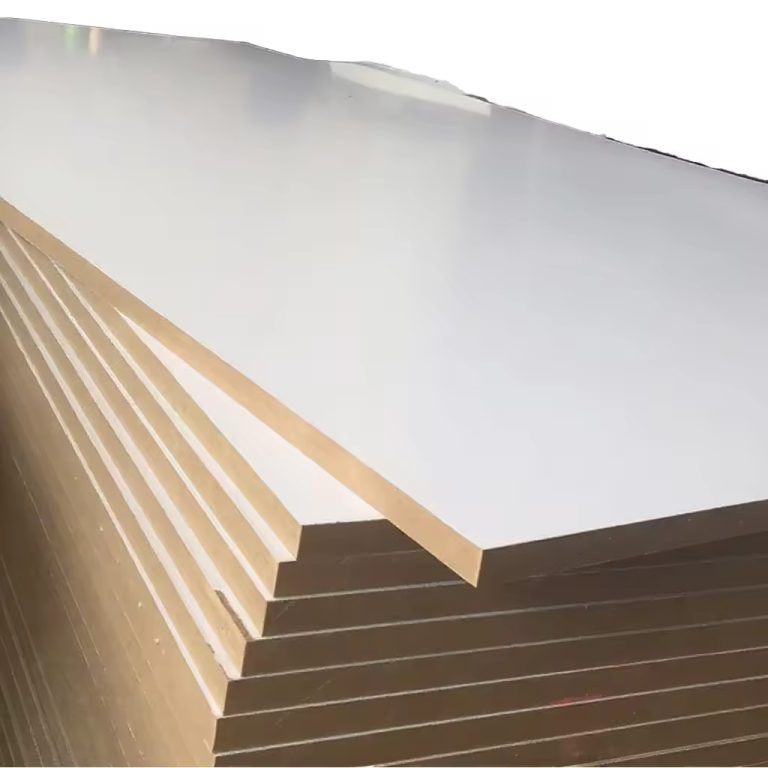
- MDF (medium-density fibreboard): wood is broken down into fine fibres, mixed with resin, spread into a thick mat and hot-pressed. The result is an even board with no grain and no voids. See it made in 3D.
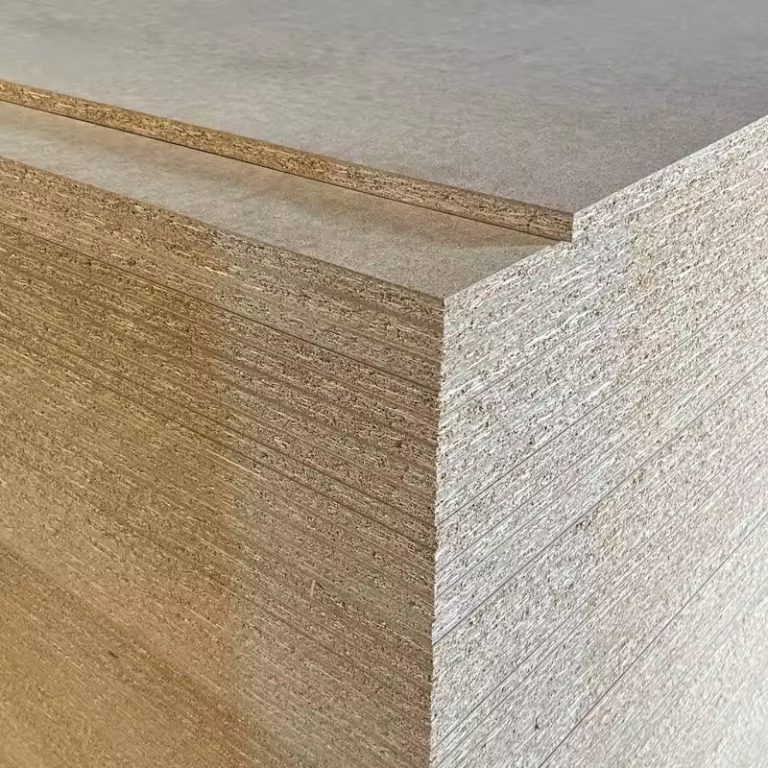
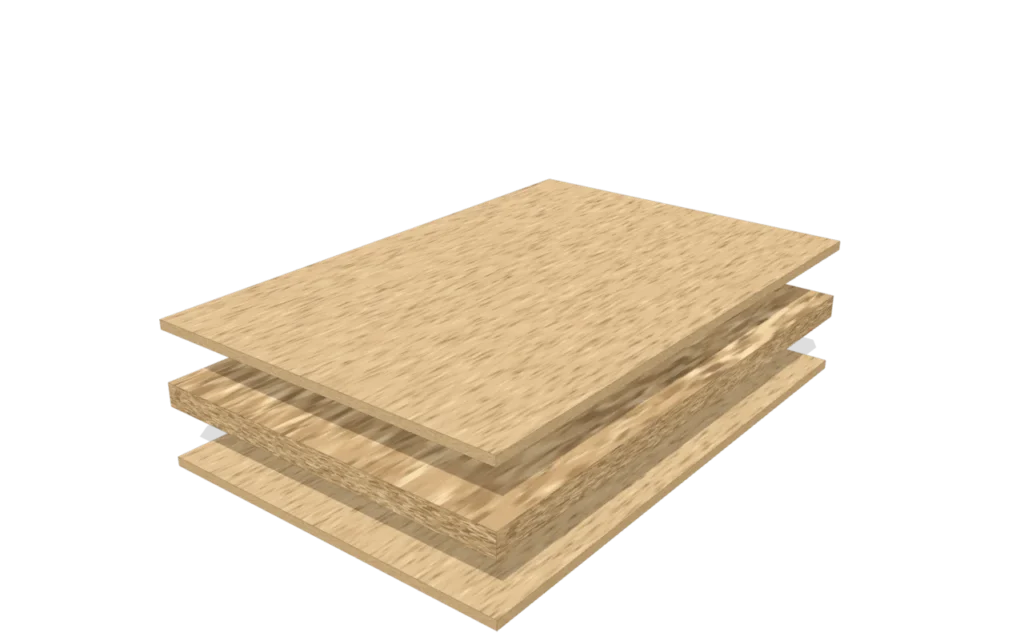
- Particle board (chipboard): wood chips are dried, screened and coated with resin, then pressed. Many boards are formed in three layers, with fine particles on both faces and coarser chips in the core. See it made in 3D.
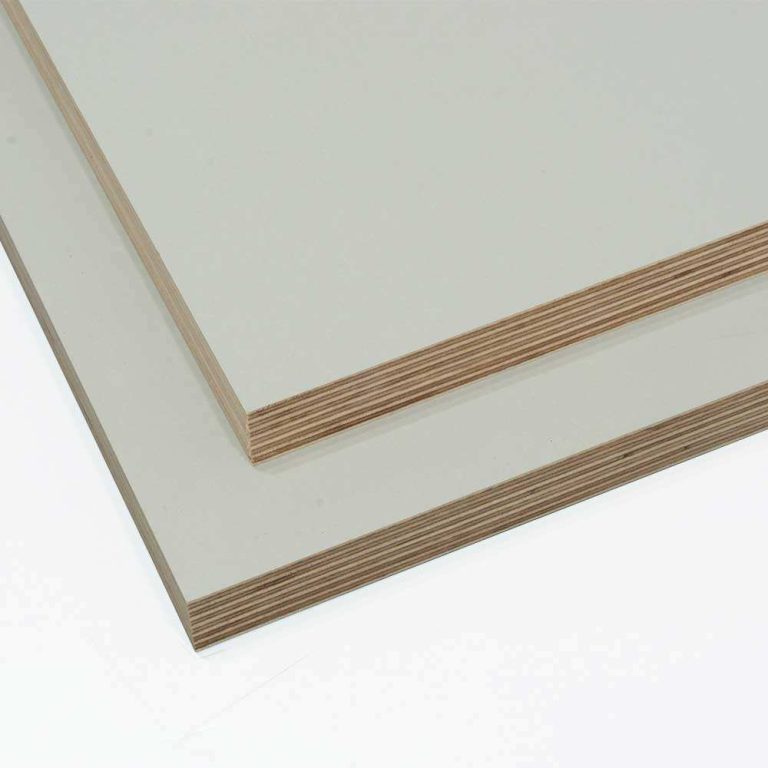
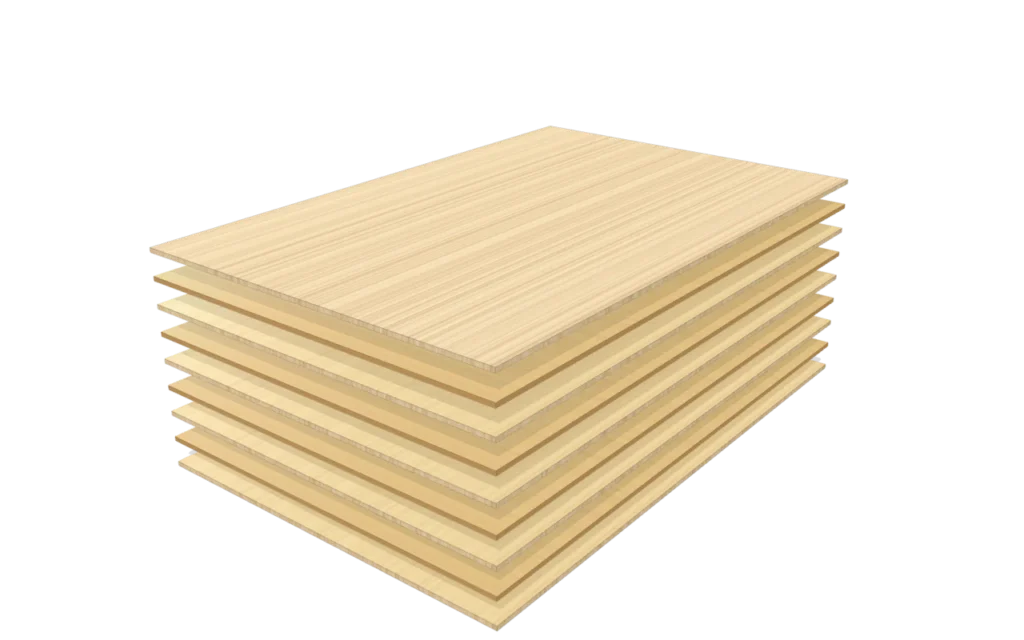
- Plywood: thin veneers are peeled from logs, dried, glued and laid up with the grain of each layer crossing the one below, then hot-pressed. See it made in 3D.
Side-by-Side Comparison
| MDF | Particle board | Plywood | |
|---|---|---|---|
| Made from | Wood fibres and resin | Wood chips and resin | Cross-laminated veneers and glue |
| Surface | Very smooth, no grain | Smooth face, coarse core | Wood grain; quality depends on the face veneer |
| Machining and edges | Cuts and routes cleanly into profiles | Edges chip; usually edge-banded | Clean, but the edges show the layers |
| Screw holding | Good in the face, weaker in the edges | Lowest, especially in the edges | Best, in the face and the edges |
| Stiffness over long spans | Medium | Lowest | Highest |
| Moisture | Swells unless a moisture-resistant grade is used | Swells the most when wet | Copes best of the three with a suitable glue |
| Painting | Best surface for paint | Not usual; laminated instead | Possible; the grain may show |
| Relative cost | Medium | Lowest | Highest |
| Typical uses | Painted doors and fronts, mouldings, wall panels, laminated furniture | Cabinet carcasses, wardrobes, shelves, office furniture | Cabinets, furniture frames, shelves, millwork |
MDF: Smooth, Even and Easy to Machine
Because MDF has no grain, it machines cleanly in every direction and takes paint, primer, laminate and veneer evenly. That makes it the usual choice for painted cabinet doors, drawer fronts, routed profiles, mouldings and decorative wall panels.
Its limits: it is heavy, screws hold less well in the edges than in the face, and standard MDF swells if water reaches the core. For kitchens, bathrooms and humid climates, specify a moisture-resistant grade and seal the edges. Melamine-faced MDF adds a ready-finished decorative surface for furniture and cabinets. See our MDF boards and melamine MDF.
Particle Board: The Cost-Efficient Choice for Flat Panels
Particle board is the most economical of the three. With a melamine face it becomes melamine board: a ready-to-use panel for wardrobes, kitchen and bathroom carcasses in dry areas, office furniture and shelving. The smooth fine-particle faces take melamine paper well.
Its limits: the coarse core makes the edges chip when machined, so the edges are normally banded; screws pull out more easily, so fittings need the right fasteners; long shelves sag under load; and the board swells if water gets in. See our raw particle board and melamine board.
Plywood: Strength and Screw Holding
Crossing the grain from layer to layer gives plywood high strength for its weight, good stiffness over long spans and the best screw holding of the three, in the face and in the edges. With a suitable glue it also copes best with humidity. That suits cabinet carcasses in kitchens and bathrooms, furniture frames, long shelves and millwork.
Its limits: it costs more, the face shows wood grain (and its quality depends on the face veneer grade), and the layered edges need banding or a deliberate exposed-edge design. See our cabinetry plywood panel.
Which Board for Which Job?
- Kitchen and bathroom cabinet carcasses: plywood or moisture-resistant MDF where humidity is high; melamine-faced particle board for dry areas and tight budgets.
- Painted cabinet doors and drawer fronts: MDF.
- Long shelves and heavy loads: plywood, or a thicker board with extra support.
- Wardrobes and office furniture: melamine-faced particle board or melamine MDF.
- Wall panels and interior decoration: MDF or melamine MDF for smooth or decorative faces; plywood where fixings carry load.
- Door casings and mouldings: MDF for primed profiles; plywood or LVL where strength and screw holding matter. See our door casings.
Moisture: None of the Three Is Waterproof
Standard MDF and particle board swell when water reaches the core, and the swelling does not go back down. Moisture-resistant MDF and plywood made with a water-resistant glue cope better with humid rooms, but every board still needs sealed edges and a protected face in kitchens and bathrooms. For walls in wet areas, WPC wall panels are an alternative that resists moisture, rot and insects.
Emission Grades: E0, E1 and E2
The grades describe how much formaldehyde a board releases: E2 releases the most, E1 less and E0 the least. Limits and test methods differ between standards and markets, so tell your supplier which standard your market uses and confirm the grade against it before you order. Our MDF, particle board and melamine boards are available in E0, E1 or E2; our plywood in E0 or E1.
What We Supply
All of these boards are made in our own plant, and they can share a container with our door casings, skirting and wall panels.
| Board | Model | Details |
|---|---|---|
| Plywood | BPL‑1 | 2440 × 1220 mm or custom; 12, 15, 18 or 22 mm thick or custom; tolerance ±0.8 mm; moisture content 8–12 %; E0 or E1 |
| MDF board | BMDF‑2 | Smooth, flat surface for lamination and processing; density 650–850 kg/m³; E0, E1 or E2 |
| Moisture-resistant MDF | BRMDF‑1 | Sanded, smooth and flat; density 730 kg/m³; E0, E1 or E2 |
| Melamine MDF | BMDF‑1 | Moisture-resistant MDF core with a melamine surface; density 650–850 kg/m³ or custom; E0, E1 or E2 |
| Particle board | BR‑1 | Sanded surface; density 730 kg/m³; E0, E1 or E2 |
| Melamine particle board | BM‑1 | Glossy, matte, embossed, woodgrain or custom faces; density 730 kg/m³ or custom; E0, E1 or E2 |
Lead time for custom orders is 15–30 days. The minimum order is one 20ft container, and it is negotiable.
FAQ
Is MDF stronger than particle board?
For most furniture uses, yes. MDF is more uniform, holds screws better in the face and machines more cleanly. Particle board costs less and works well for flat, lightly loaded panels, especially with a melamine face.
Is plywood better than MDF for kitchen cabinets?
It depends on the part. Plywood is the stronger, more humidity-tolerant choice for carcasses and shelves; MDF gives the smoother finish for painted doors and drawer fronts. Many kitchens combine both.
Can MDF be used in bathrooms?
Only a moisture-resistant grade, with sealed edges and a protected finish, and away from standing water. Standard MDF is not suitable.
What is melamine board?
A particle board or MDF core pressed between two sheets of melamine-impregnated décor paper. The surface is finished at the factory, so the panel needs no painting. See how it is made in our melamine board 3D view.
Which board holds screws best?
Plywood, in both the face and the edges. MDF holds well in the face but less in the edges. Particle board holds least, so use fasteners and fittings designed for it.
Ordering Boards?
Tell us the board type, thickness, sheet size, surface, emission grade, quantity and destination. We will confirm the specification and add the boards to the same container as your other products if you wish.